

Ponuka INVEST webinárov - jún 2026
01.06.2026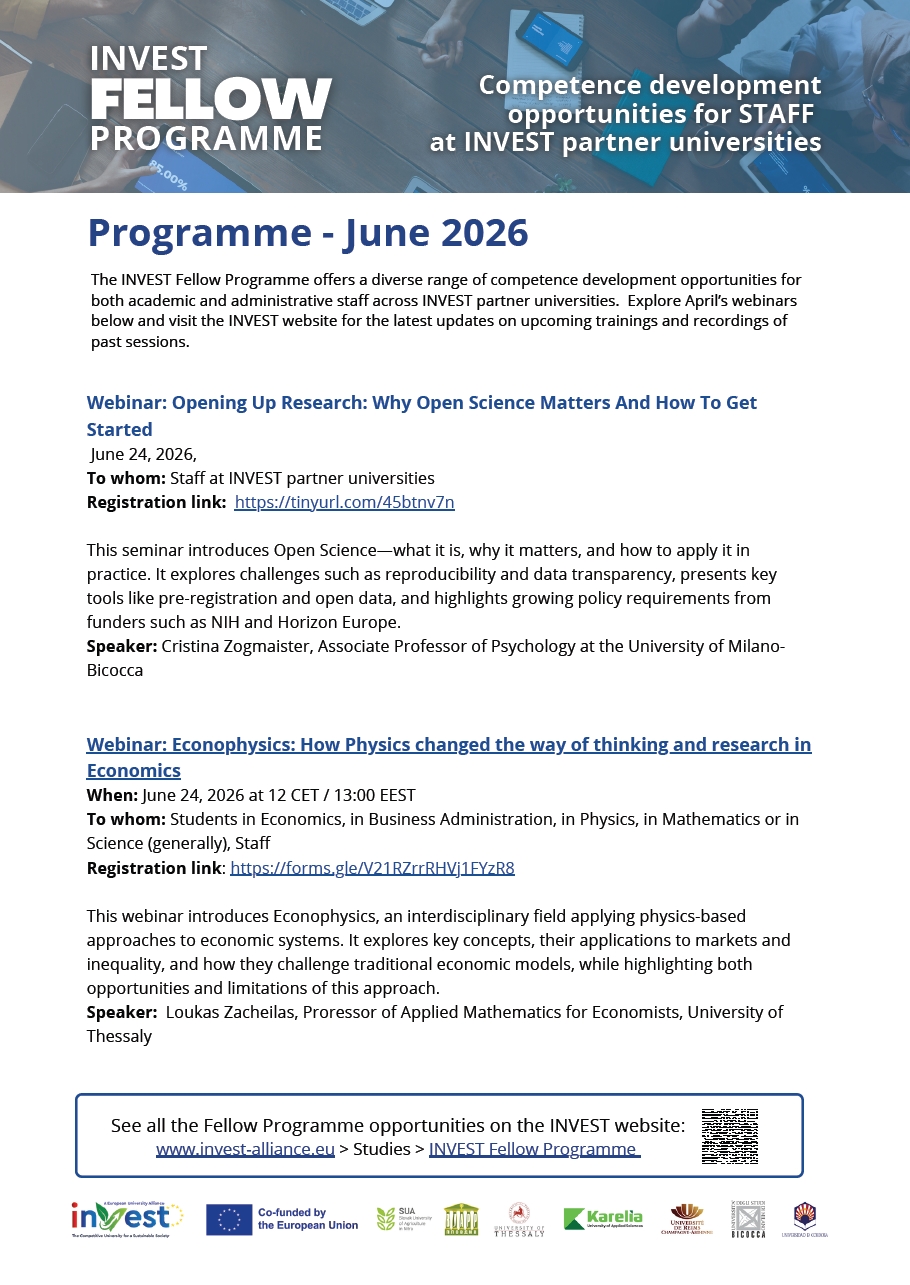
Webinar: Opening Up Research: Why Open Science Matters And How To Get Started
June 24, 2026,
To whom: Staff at INVEST partner universities
Registration link: https://tinyurl.com/45btnv7n
This seminar offers an accessible introduction to Open Science: What it is, why it matters, and what concrete steps researchers, students, and administrators can take to embrace it. The starting point is a diagnosis. Recent large-scale investigations reveal that a substantial portion of published findings across multiple scientific fields fail to replicate when independently tested, and that only a fraction of papers make their data available for reproducibility checks. What are the structural roots of these problems? Publication incentives, opaque methods, and the analytical flexibility that comes with undisclosed researcher choices.
Building on this diagnosis, the seminar introduces the Open Science toolkit (pre-registration, open data and materials, transparent reporting, and open access), considering both their rationale and practical first steps to implement them. The seminar closes by situating these practices in the current policy landscape, where funders such as NIH and Horizon Europe now mandate open access and data sharing, making Open Science not just an ethical ideal but an increasingly concrete institutional requirement.
Speaker: Cristina Zogmaister, Associate Professor of Psychology at the University of Milano-Bicocca
Webinar: Econophysics: How Physics changed the way of thinking and research in Economics
When: June 24, 2026 at 12 CET / 13:00 EEST
To whom: Students in Economics, in Business Administration, in Physics, in Mathematics or in Science (generally), Staff
Registration link: https://forms.gle/V21RZrrRHVj1FYzR8
Econophysics is an interdisciplinary field that emerged over the last decades, transferring tools, methods, and modes of reasoning from Statistical Physics and the theory of complex systems to the study of economic phenomena. This webinar will present how concepts such as power-law distributions, phases and phase transitions, networks, and collective behavior have contributed to a new understanding of financial markets and economic inequality. It will highlight the critique that
Econophysics poses to traditional neoclassical models, particularly regarding assumptions of rationality and normality. At the same time, characteristic examples of successful applications will be discussed, along with the limitations and open challenges of this approach. The aim of the talk is to demonstrate that Physics did not merely provide Economics with new mathematical tools, but introduced a fundamentally different scientific way of thinking for the study of complex socio-economic systems.
Speaker: Loukas Zacheilas, Proressor of Applied Mathematics for Economists, University of Thessaly